



Welcome to the Research and Strategy Services at in today's fast-paced.
As a clinician who founded the Breakthrough ADHD Center I have has spent decades working with gifted ADHD children, teens, and adults. From this experience I’m very selective about the tools I bring into my practice. Many cognitive apps and programs make big promises but offer little scientific evidence or real-world impact.
NeuroTrackerX was different from the start.
I first encountered it during my own recovery from a difficult and enduring brain trauma. My attention felt fragmented, and my stamina was limited. In particular, I had problems with visual tracking and hand-eye coordination, which made simple things like using a knife and fork major challenges. NeuroTrackerX became one of the few tools that helped me rebuild those skills — slowly, gently, and measurably.
That experience stayed with me. When I later began integrating NeuroTrackerX into my work with ADHD clients, I recognized how powerful it could be in a clinical setting, especially when used under professional guidance.
This review explains why NeuroTrackerX has become a core part of my clinical work, and more importantly, why I believe professionals and clinics can achieve better results with it than clients training alone.
NeuroTrackerX is a perceptual-cognitive training platform designed to strengthen core attentional and processing systems that are commonly challenged in ADHD. It uses 3D multiple object tracking in 6-minute sessions. Here is a 2D video overview of a session:
This task places controlled demands on foundational cognitive functions such as:
• sustained and divided attention
• visual processing and tracking
• working memory under load
• mental stamina and cognitive flexibility
Unlike many cognitive apps, NeuroTrackerX does not rely on language, academic skills, or strategy learning. This makes it especially well suited for ADHD populations, including children, teens, and adults who struggle with frustration, performance anxiety, or uneven skill profiles.
In a clinical context, NeuroTrackerX functions as both a training tool and an observational window. Because performance adapts continuously to the individual, it allows clinicians to see how attention, fatigue, stress, motivation, and emotional regulation interact in real time. Patterns often emerge quickly, providing insight that complements traditional assessments and therapy.
The NeuroTrackerX platform extends this further by allowing professionals to customize training parameters, monitor sessions remotely, and adjust programs responsively. This transforms NeuroTrackerX from a standalone exercise into a non-medical clinician-directed intervention that flexibly integrates into broader ADHD care.
Used properly, NeuroTrackerX is not about pushing performance — it is about creating a safe, measurable way for ADHD clients to experience challenge, progress, and cognitive resilience under supportive guidance.
Most tools I use fall into one of two categories:
• They are clinically meaningful but lack research, or
• They are research-backed but not very applicable in real life.
NeuroTrackerX is one of the rare tools backed by decades of peer-reviewed research, including:
• attention training
• cognitive load
• perceptual decision-making
• cognitive impairment
• athletic performance
• aging and resilience
• clinical populations
This depth of science matters when I’m choosing tools for families who are tired of trial-and-error.
Professionals can appreciate NeuroTrackerX because it’s not a trend — it’s a well-validated cognitive training method used by research institutes, elite military and sports teams, as well as medical groups. That credibility gives clinicians a foundation they can trust.

Many ADHD families try structured cognitive training on their own.
Unfortunately children can:
• get overwhelmed,
• feel defeated by inconsistent scores,
• lose motivation over time.
This is where professionals make all the difference.
ADHD brains are sensitive. They need:
• the right starting point,
• the right pacing,
• the right expectations,
• and someone who knows how to interpret dips and plateaus without triggering shame.
Both in clinic and remotely, I can adjust NeuroTrackerX’s speed, targets, duration, and session types in ways that match each client’s emotional state, cognitive load, and sensitivity level. In addition NeuroTrackerX has a variety session types, which emphasize different attentional skills, such as selective or divided attention, which I can use to build customized programs according to client’s specific needs.
I also use a structured onboarding method which I developed through consultation with the NeuroTrackerX team. It’s what I call the High Success Program, and it helps to ensure early success, especially for children who are easily discouraged.
This early success is essential for ADHD. Once my clients experience their own improvement, motivation naturally grows.
One of the most useful aspects of NeuroTrackerX is how transparent progress is.
I can quickly see:
• when a child’s energy drops
• when poor sleep makes their frustration rise faster
• when stress shows up in their body and their focus shrinks
• when medication timing influences their emotional steadiness and task flow
• when emotional load slows their thinking
• when fluctuating attention creates moments of self-doubt
When their confidence grows and they’re ready for the next level of challenge. This gives me real-time insight into what’s happening in a child’s life — insight I couldn’t get from talk therapy alone.
Gifted ADHD children are some of the most sensitive I work with.
They become overwhelmed quickly, shut down when tasks feel difficult, or feel ashamed when performance drops.
NeuroTrackerX allows me to tailor the task so they feel safe, capable, and in control:
• Fewer targets on difficult days
• Slower speeds during overwhelm
• Quick session types when attention tanks
• Higher-challenge days for confidence building
This adaptability is why some of my most anxious or perfectionistic clients have stayed consistent with NeuroTrackerX when they couldn’t tolerate other cognitive tools.
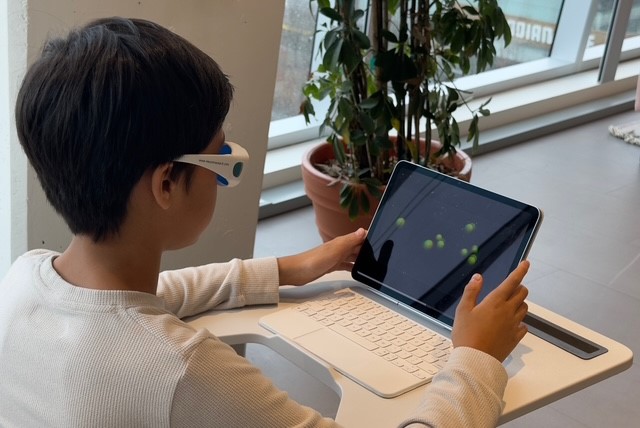
Over the years, my ADHD clients have reported (or demonstrated) improvements in:
• focus and sustained attention
• mental stamina
• emotional steadiness
• homework endurance
• sports and movement coordination
• self-confidence
• adaptability in stressful environments
• social responsiveness
These gains often appear in multiple areas at once, which is rare for ADHD interventions.
When ADHD children finally see themselves improve in a measurable way, something opens up internally. Their confidence and effort levels shift. That emotional progress can be just as important as the cognitive gains.
I’ve used many brain-based tools over the years. The NeuroTrackerX platform stands out because it helps me:
• create custom programs
• monitor remote training accurately
• adjust difficulty in real time
• support kids through emotional ups and downs
• track long-term patterns
• adapt for trauma-sensitive or perfectionistic profiles
• integrate training into broader neurofeedback or counseling plans
NeuroTrackerX feels like a tool designed with clinicians in mind — not just families.
It matches how I already work: individualized, relationship-based, and rooted in understanding each child’s emotional world.

Neurofeedback, counseling, nutrition, and mindset work are all essential pieces of ADHD support.
But NeuroTrackerX adds something unique:
• measurable cognitive change
• engagement in a challenge that feels achievable
• a sense of mastery students can feel in their bodies
• a bridge between emotion and attention
It fits naturally into an integrative ADHD approach and to help strengthen everything around it.
NeuroTrackerX isn’t a magic fix for ADHD.
But used properly — especially under clinical supervision — it is one of the most adaptable, evidence-backed, emotionally safe, and meaningfully engaging tools I’ve ever used in my practice.
For clinics and professionals working with ADHD, it offers something rare:
A way to help clients build attention, resilience, and confidence — not through pressure or perfectionism, but through measurable mastery, emotional safety, and consistent growth.
And for many ADHD children (and their families), it can be life-changing.
For clinicians curious about the training experience, a 2D assessment version of NeuroTrackerX can be tried for free here.
Welcome to the Research and Strategy Services at in today's fast-paced.

Dr. Sean Fletch explains why long-term health depends less on chasing fragmented health advice, and more on understanding the biological rules that preserve capacity and resilience over time.
Understand why progress in ADHD can feel inconsistent — and how to recognize real improvement over time.
Learn why ADHD children can focus intensely on some tasks but struggle with others — and how to support better attention regulation.
NeuroTracker is one of the most widely researched cognitive training systems, used in elite sports, military, and human performance settings worldwide. Built on 20 years of neuroscience research.