September 2014
in
Journal of Strength and Conditioning Research
The purpose of this study was to determine the relationship between visual tracking speed (NeuroTracker) and reaction time on basketball specific measures of performance.
12 professional NBA basketball players (Orlando Magic) were tested with a 1-session NeuroTracker baseline (6-mins), reaction time assessment, and the were results compared to competitive performance metric across an NBA season. Competition data analysis focused on Assists, Turnovers, Assist-to-turnover ratio, and Steals.
Finding show that relationships between NeuroTracker baselines were most strongly correlatedwith Assist-to-turnover ratio, and Turnovers. Backcourt players were more likely to outperform frontcourt players in AST and accordingly very likely to achieve higher NeuroTracker performance. Reaction time was not related to any of the basketball-specific performance measures. Overall a single NeuroTracker session baselines showed significant correlation to the NBA players’ ability to see and respond to various stimuli on the basketball court in ways that resulted in better performance.

NeuroTracker training may support improvements in athletes’ self-reported sport imagery ability
To examine whether perceptual-cognitive training with NeuroTracker could influence sport imagery ability among athletes.
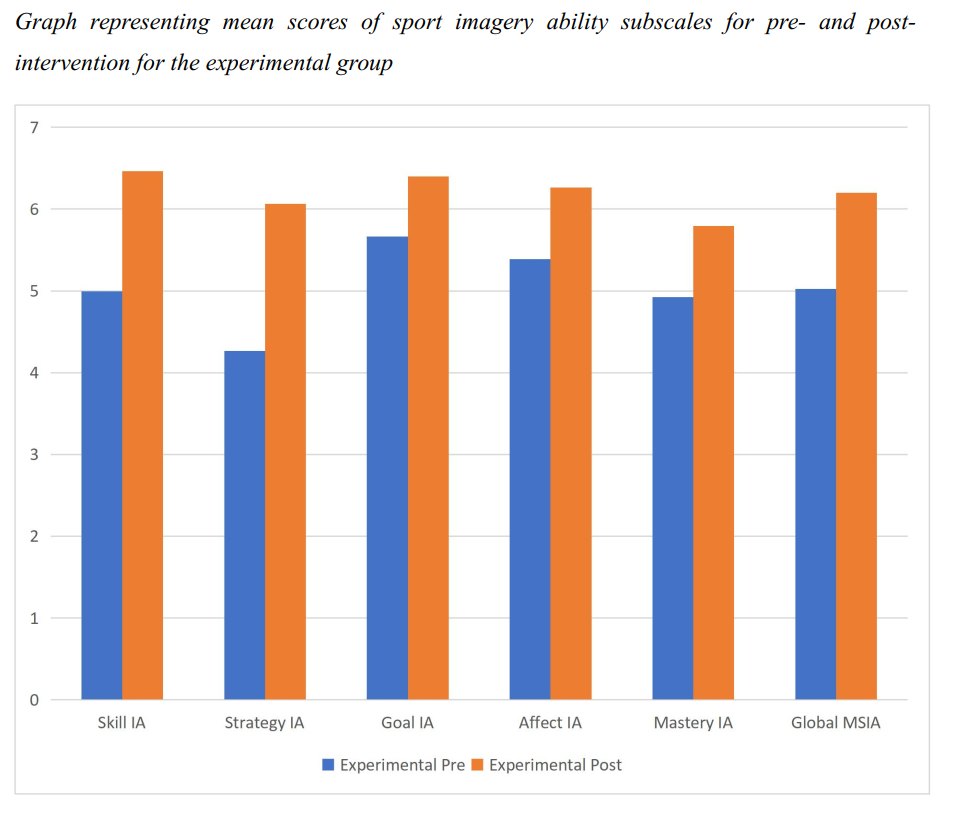
10 athletes from the National Sports University in India were randomly assigned to an experimental group or active control group. The experimental group completed a 5-week NeuroTracker training program consisting of 30 adaptive training sessions. The control group completed Quickboard coordination training focused on agility, speed, and leg reaction. Imagery ability was assessed before and after the intervention using the Sports Imagery Ability Questionnaire, which measures imagery across skill, strategy, goal, affect, mastery, and global sport imagery domains.
Athletes in the NeuroTracker group showed improvements across all imagery domains from pre- to post-intervention. Within-group analysis showed significant improvements in strategy imagery, goal imagery, affect imagery, and the global measure of sport imagery ability. Post-intervention comparisons between the NeuroTracker and control groups showed significant differences for strategy imagery and global sport imagery ability, while skill, goal, affect, and mastery imagery did not show statistically significant between-group differences.
Overall, the findings provide preliminary evidence that perceptual-cognitive training may positively influence self-reported sport imagery ability, particularly strategy-related imagery and overall imagery ability. Due to the very small sample size, these results should be interpreted cautiously and followed up with larger studies.
Home-based NeuroTrackerX training improved working memory performance in competitive soccer players, with corresponding changes in brain activity.
To examine whether home-based NeuroTrackerX training improves cognitive performance and modulates brain activity in university-level soccer players.
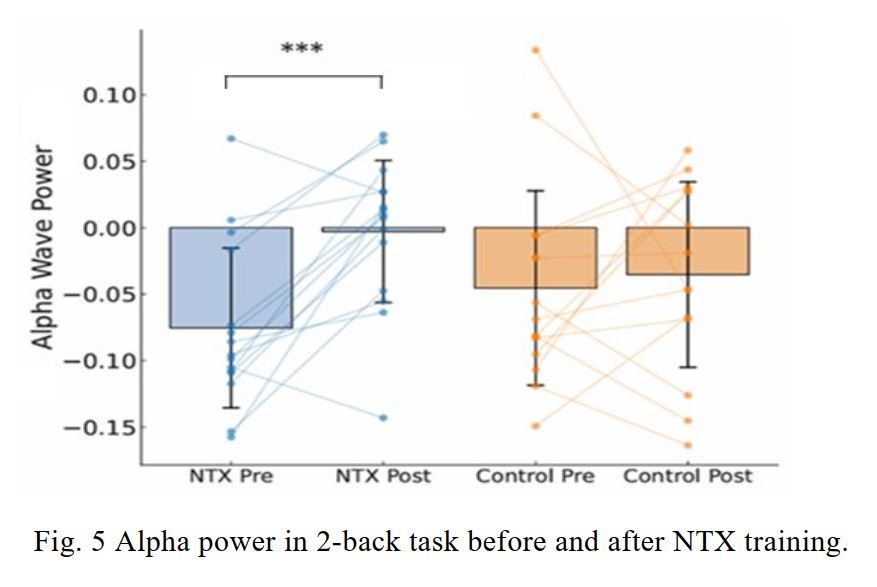
Twenty-nine male university soccer players were assigned to either an NeuroTracker training group (30 home-based sessions over 9 weeks) or a control group continuing regular activities. Pre- and post-intervention assessments included NeuroTracker performance (3D-MOT), 2-back and 3-back working memory tasks, and EEG recordings (Fz) during n-back task performance.
The NeuroTracker group showed a significant increase in NeuroTracker scores post-training (p < .001), while the control group did not. Performance improved to approximately 128–130% of baseline after ~30 sessions, confirming effective learning in a home-based self-training format.
A significant improvement was observed in 2-back accuracy (p = .045) in the NeuroTracker group only, suggesting transfer to working memory and attentional updating under moderate load. No significant improvements were observed in the more demanding 3-back condition. Both groups responded faster at post-test, likely reflecting practice effects rather than training-specific changes.
During the 2-back task, alpha-band power (Fz) increased significantly post-training in the NeuroTracker group (p < .001). The authors interpret the alpha increase as reflecting improved attentional regulation and neural efficiency (inhibitory gating).
Intensive sports training may offset the perceptual–cognitive disadvantage associated with being relatively younger within an age cohort during childhood and adolescence.
To examine whether relative age (birth quartile), training background, and stereopsis influence perceptual–cognitive performance measured using a 3D multiple object tracking (3D-MOT) task in youth athletes.
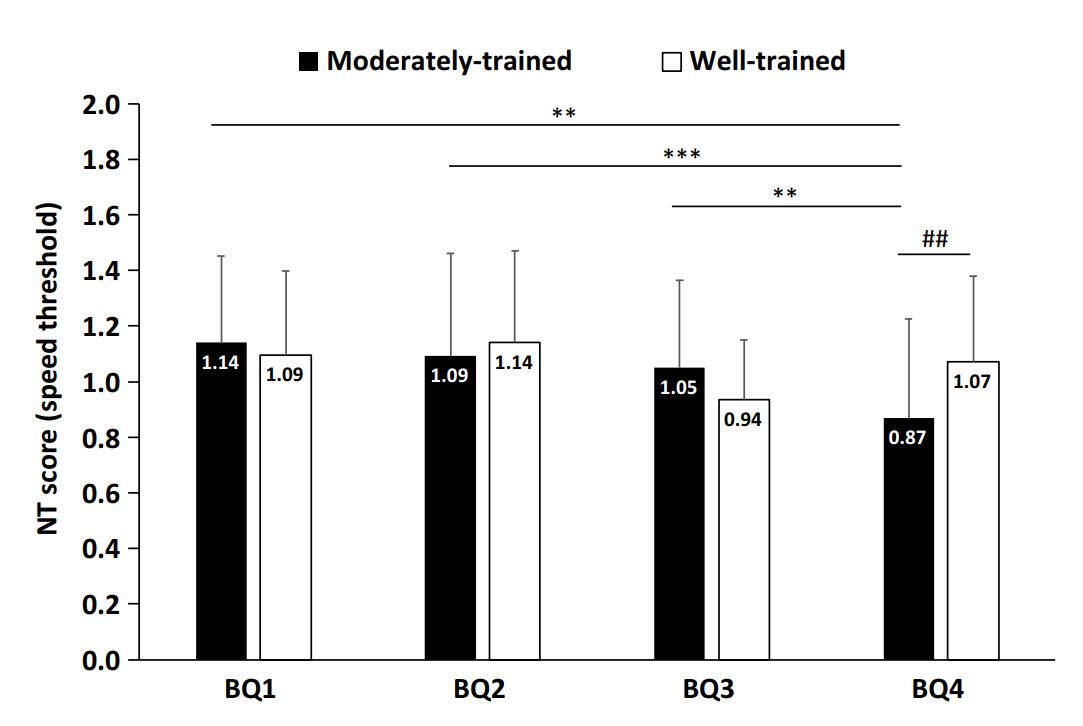
A total of 165 male youth athletes aged 10–16 years were categorized by birth quartile and training exposure (moderately trained: 1–2 sessions/week; well-trained: 4–5 sessions/week). Participants completed a standard NeuroTracker 3D-MOT protocol under both stereoscopic (3D) and non-stereoscopic (2D) conditions. Speed thresholds were calculated using an adaptive staircase procedure and compared across groups.
Among moderately trained athletes, those born earlier in the selection year outperformed relatively younger peers, demonstrating a perceptual–cognitive Relative Age Effect. However, in well-trained athletes, performance differences between birth quartiles disappeared, with later-born athletes achieving comparable tracking thresholds. Performance was significantly higher in 3D versus 2D conditions, but stereopsis did not interact with birth quartile or training status.
These findings suggest that structured training exposure may mitigate perceptual–cognitive disadvantages associated with relative age during development.
Dynamic visual tracking performance in young basketball players does not significantly decline following cognitive fatigue induced by a Stroop task.
To investigate whether acute cognitive fatigue, induced via a Stroop task, affects multiple object tracking performance in young basketball athletes.
Participants were young basketball players who completed a standard Stroop task designed to induce cognitive fatigue. After the Stroop protocol, participants were assessed on a 3D multiple object tracking (3D-MOT) task to evaluate perceptual-cognitive tracking performance under fatigued cognitive conditions. Performance on the NeuroTracker task was compared between the fatigue condition and either baseline or control conditions.
Participants’ 3D-MOT performance did not show a significant decrement following Stroop-induced cognitive fatigue. Dynamic tracking thresholds and accuracy remained statistically similar across the fatigued and non-fatigued conditions, suggesting that the athletes’ perceptual-cognitive tracking ability was resilient to this laboratory-induced mental fatigue protocol.
NeuroTracker 3D-MOT baseline performance was established using CORE sessions, and the intervention showed gains in tracking ability though broader performance transfer was limited.
To evaluate the effects of a vision training program — including 3D multiple object tracking (3D-MOT) as implemented in NeuroTracker — on perceptual-cognitive performance in an athletic or high-performance context.
Participants completed baseline NeuroTracker assessments using the standard CORE program (three CORE sessions and one sustained attention session) to establish baseline dynamic tracking speed thresholds. The training protocol involved repeated 3D-MOT sessions embedded within a broader vision training regimen. Performance was assessed pre- and post-training.
Baseline assessments used the NeuroTracker CORE protocol to quantify tracking thresholds. Post-training increases in baseline tracking performance were observed, suggesting that repeated 3D-MOT exposure enhanced basic perceptual-cognitive tracking ability. However, the pilot nature of the study and limited transfer to broader functional outcomes indicate that while 3D-MOT improves task-specific performance, the broader utility for real-world or sport performance remains preliminary.
Baseline NeuroTracker performance was not significantly associated with overall season performance metrics in university varsity athletes.
To determine whether baseline NeuroTracker performance predicts overall season sport performance in university varsity athletes.
University varsity athletes completed baseline NeuroTracker assessments prior to their competitive season. Objective season performance statistics were collected and analyzed to evaluate potential associations between baseline perceptual-cognitive tracking ability and in-season performance outcomes.
No significant correlation was found between baseline NeuroTracker performance and overall season sport performance metrics. These findings suggest that baseline perceptual-cognitive tracking ability alone may not directly predict aggregate competitive outcomes, highlighting the multifactorial nature of sport performance.

NeuroTracker is one of the most widely researched cognitive training systems, used in elite sports, military, and human performance settings worldwide. Built on 20 years of neuroscience research.