NeuroTracker has been tried and tested by many independent research centres across the world. Discover the diverse research published with our searchable database
Published Research Papers
Research Institutes Using NeuroTracker
Issued Patents and Patents Pending
Dark sweet cherry supplementation improved working memory in obese adults but did not enhance NeuroTracker-measured visual cognitive performance beyond practice-related gains.
To evaluate whether 30 days of dark sweet cherry (DSC) consumption improves executive function, NeuroTracker 3D-MOT performance, neuropeptide levels, and circadian rhythm biomarkers in adults with obesity.
Extended 3D-MOT training improved tracking performance but did not transfer to measurable in-game soccer performance metrics.
To examine whether improvements in 3D-MOT performance transfer to objective in-game performance outcomes in competitive soccer players.
Domain-specific cognitive training led to measurable improvements in executive function performance in youth elite soccer players.
To investigate whether domain-specific cognitive training can enhance executive function performance in youth elite soccer players.
NeuroTracker learning rates between collegiate male and female athletes and non-athlete peers reveals the cognitive neurodevelopmental benefits of sports.
To investigate playing sports influences cognitive capacities measured by NeuroTracker, as well as to see if such effects differs between young males and females.
A single 6-min NeuroTracker baseline correlates to key professional soccer performance metrics over two seasons of play.
To investigate the relationship with NeuroTracker baselines and soccer player performance metrics across two professional seasons.
To examine the effects of 14-days ATP supplementation (adenosine 5′-triphosphate) on NeuroTracker visual tracking speed, reaction time, mood and cognition in a double-blind crossover study.
NeuroTracker baseline reveal stroboscopic vision training does not improve perceptual-cognitive skills, but may aid anticipation skills.
To analyze the repeated effect of stroboscopic vision training on perceptual-cognitive and anticipation skills in soccer players.
Rigorous feasibility study finding NeuroTracker to have high accessibility and adherence for at-home independent cognitive training.
To investigate the feasibility of using a remote therapeutic cognitive intervention for brain injury survivors using an at-home training program.
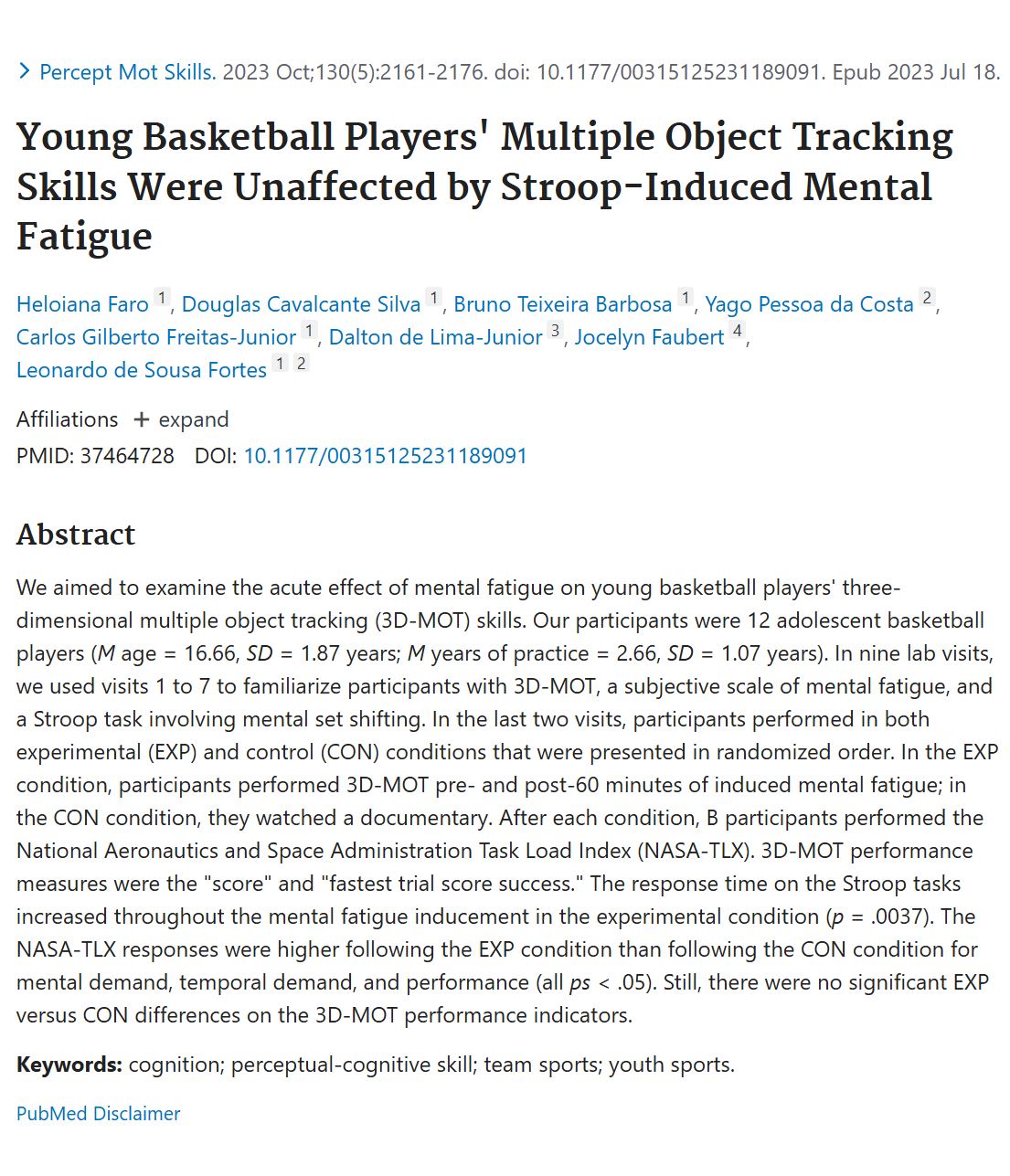
Dynamic visual tracking performance in young basketball players does not significantly decline following cognitive fatigue induced by a Stroop task.
To investigate whether acute cognitive fatigue, induced via a Stroop task, affects multiple object tracking performance in young basketball athletes.
Detailed analysis of dietary intake in combination with daily NeuroTracker baselines reveals key nutrient levels for optimal perceptual-cognitive performance.
To examine the influence of nutritional intake on visual perceptual-cognitive performance, measured by NeuroTracker, in young healthy adults.
NeuroTracker baselines and learning rates correlate with the dietary intake and sleep quality of esports athletes, revealing effects on cognition.
To investigate the influence of dietary intake and sleep of esports athletes on cognitive performance and learning capacities measured by NeuroTracker.
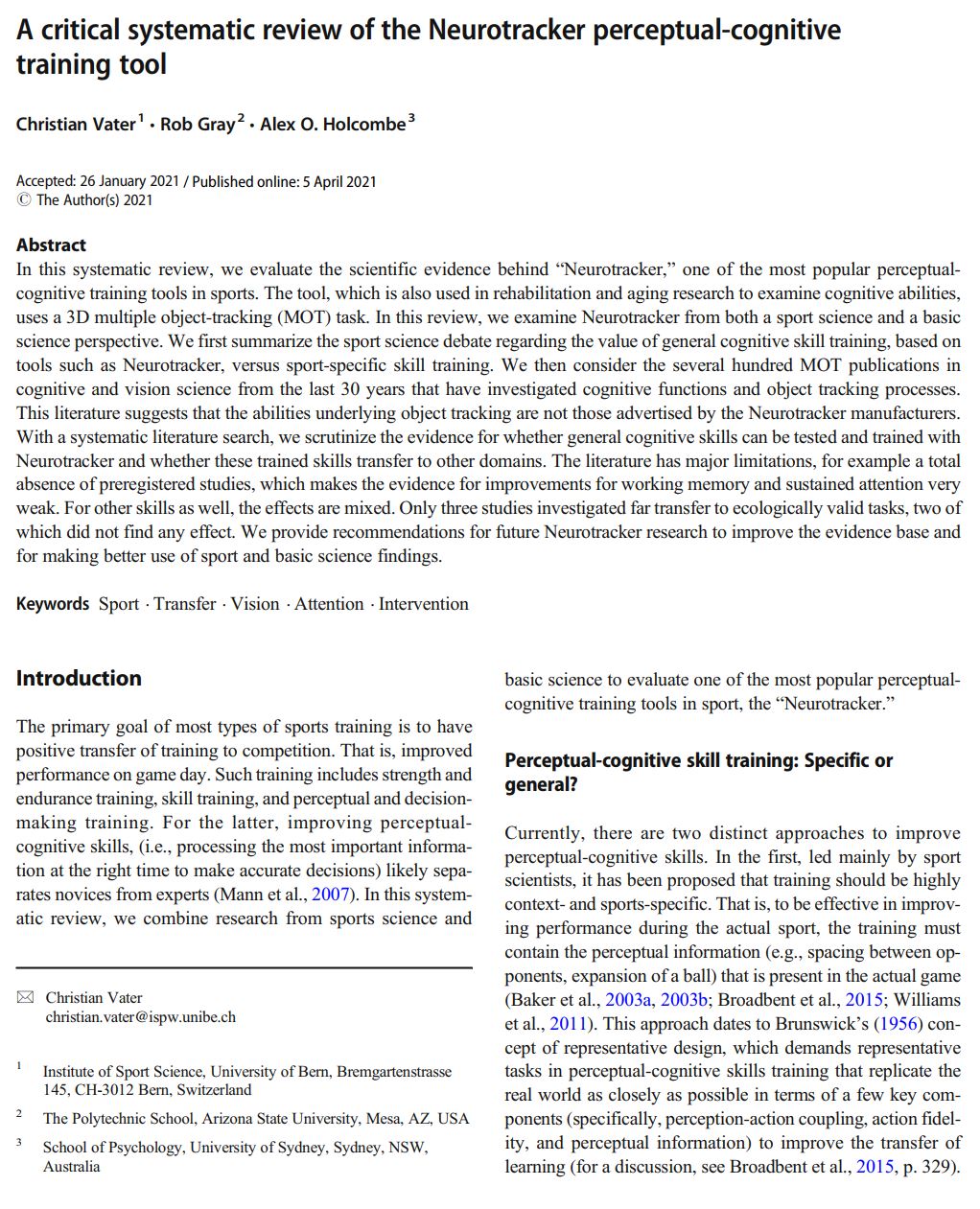
30 sessions of NeuroTracker training promotes safer driving skills on advanced driving simulators in both younger and older adults.
To investigate if NeuroTracker training can transfer to improved driving skills as measured by state-of-the-art driving simulators.
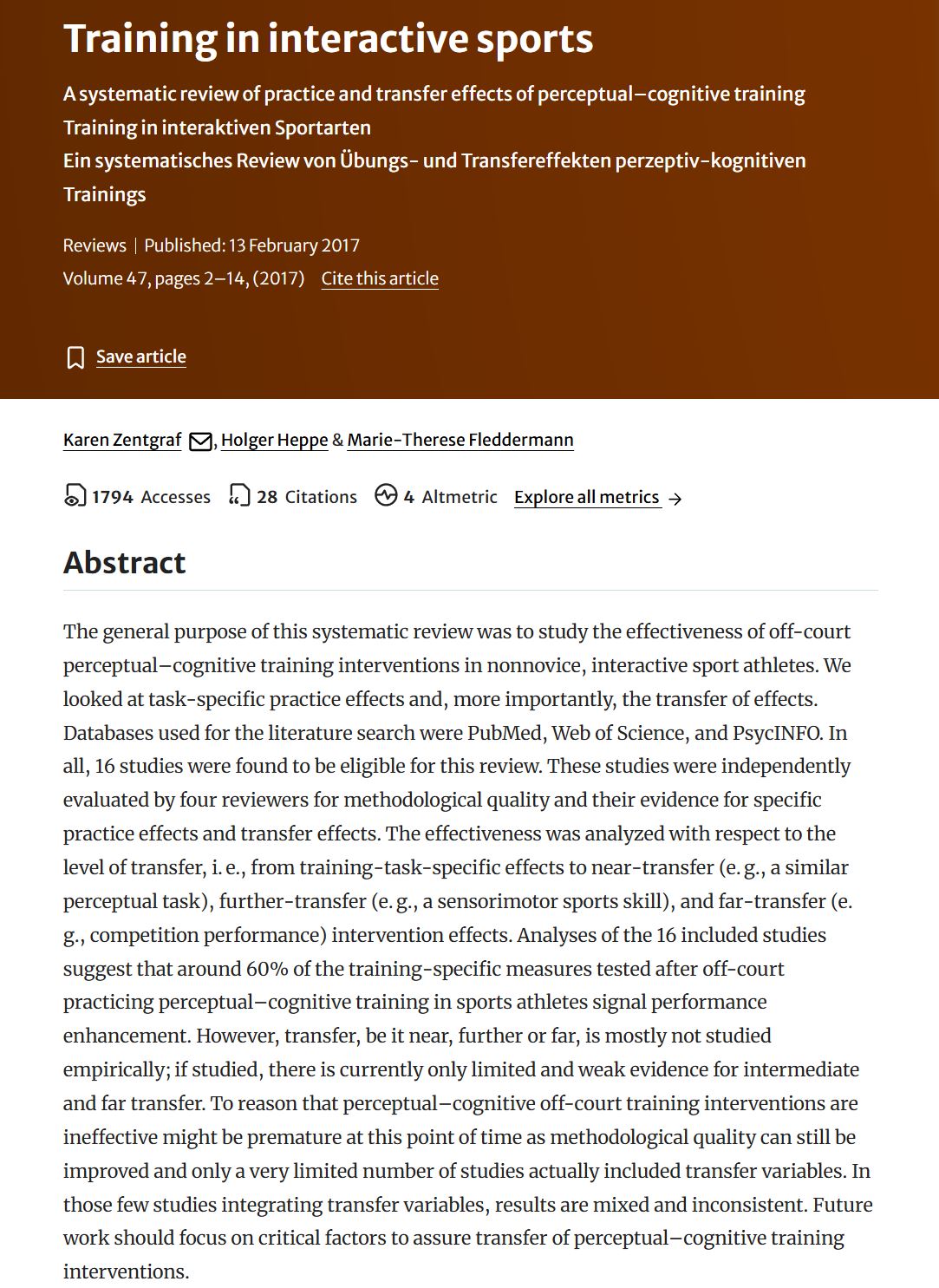
60 minutes of NeuroTracker training significantly improves soccer passing accuracy in NCAA Division 1 female soccer players.
To examine the transferability of perceptual-cognitive training using NeuroTracker to on-field soccer performance parameters.
AI modelling of NeuroTracker baselines and demographic data effectively predicts learning rate and training intervention outcomes.
To investigate if a NeuroTracker intervention could improve cognitive abilities in older adults with subjective cognitive decline, and determine if AI models could be used to increase training efficacy.
A NeuroTracker training intervention combined with adapted performance programs improves the competition results of mountain runners.
To investigate if comprehensive physical and cognitiveassessments can help improve the competitive performance of elite mountainsrunners.
NeuroTracker 3D-MOT training is more effective at inducing HRV associated flow states in young soccer players, than 2D-MOT.
To compare the learning efficiency 3D-MOT (NeuroTracker) with 2D-MOT, and investigate whether any advantages can be reflected by heart rate variability (HRV).
Statistical analysis of NeuroTracker learning reveals cognitive characteristics between attention-deficit/hyperactivity disorder, specific learning disorder, and Intellectual developmental disorder
To investigate if NeuroTracker learning rates can characterize different neurodevelopmental conditions in children.
A single NeuroTracker baseline strongly correlates with some metrics of competitive soccer performance in NCCA athletes.
To investigate the relationship between visual tracking speed (NeuroTracker) and soccer-specific performance measures.

NeuroTracker is one of the most widely researched cognitive training systems, used in elite sports, military, and human performance settings worldwide. Built on 20 years of neuroscience research.