



Welcome to the Research and Strategy Services at in today's fast-paced.

Flying an aircraft looks, from the outside, like a task of precise control.
Keep the aircraft on course. Maintain altitude. Adjust speed. Follow instructions. Respond to weather and traffic.
But experienced pilots are rarely managing only what the aircraft is doing right now. They are continuously projecting forward.
What will this descent rate mean in two minutes? What will the wind do to the approach? If the aircraft reaches that waypoint at the current speed, will the next instruction still be manageable? If weather is building ahead, what options will remain available later?
This is why pilots often talk about staying ahead of the aircraft.
The phrase does not simply mean planning well. It describes a deeper cognitive requirement: building a continuously updated picture of what is likely to happen next, early enough that there is still time to act.

An aircraft does not wait for the pilot to finish processing information.
While the pilot is checking a display, listening to air traffic control, entering a new route, or assessing weather, the aircraft continues moving through space.
At higher speeds, that creates an obvious problem - a decision that is delayed by only a short time can change what options remain available later.
A descent started too late may require a steeper correction. A turn planned too late may compress the available maneuvering space. A weather cell that looked distant several minutes ago may now be much more relevant.
The pilot therefore has to think not only in terms of present position, but in terms of future state.
Where will the aircraft be by the time this decision matters?

Much of piloting is built around expectation.
Pilots continuously anticipate how the aircraft should respond to:
They do not need to wait for every outcome to fully develop before deciding whether something is going as expected.
Instead, they compare the aircraft’s unfolding behavior with an internal prediction.
If the descent is shallower than expected, that matters.
If the groundspeed is higher than anticipated, that changes timing.
If crosswind is stronger than forecast, the planned approach may need adjustment.
In this sense, expert flying is partly a process of asking: Is reality still matching the plan?
One reason experienced pilots can appear calm in complex situations is that they often detect problems while they are still small. A minor difference in speed, altitude, heading, or timing may not yet be dangerous. But it may indicate that the aircraft is moving toward a less manageable situation.
This is a crucial distinction.
Novices are more likely to respond once the deviation becomes obvious.
Experts are more likely to notice the trend.
For example, an aircraft can still be safely above the required altitude while already becoming difficult to position for descent later.
Nothing is technically wrong yet, but the future problem is beginning to form.
Thinking ahead means recognizing that trajectory matters before outcome does.
A cockpit presents information about more than the current state of the aircraft.
Some information is immediately relevant:
Other information matters because of what it implies about the next phase:
This means pilots are constantly working across different time horizons. Some decisions concern the next few seconds. Others concern the next several minutes. Others may concern the rest of the flight.
The challenge is not simply having access to this information. It is knowing which future matters most right now.
A flight can feel manageable for a long period and then become cognitively demanding very quickly. This often happens when several future requirements begin converging.
Imagine an aircraft approaching a busy airport.
The pilot may need to:
None of these tasks is unusual on its own. The difficulty comes from timing. They all need to happen in the correct sequence, and each one affects the next.
If one step is delayed, later steps become more compressed.
This is one reason staying ahead of the aircraft is so valuable - it preserves time and options.
A useful way to understand expert piloting is that much of the skill is preventative.
The best correction is often the one that never has to become dramatic.
If the pilot anticipates a descent early, the aircraft can be positioned gradually. If a weather route is reconsidered early, the diversion can be made with more space.
If workload is anticipated before a complex phase of flight, tasks can be completed while there is still spare attention available.
This makes flying look smoother, but smooth performance can hide the amount of cognition required to produce it. What appears effortless may reflect continuous planning several steps ahead.
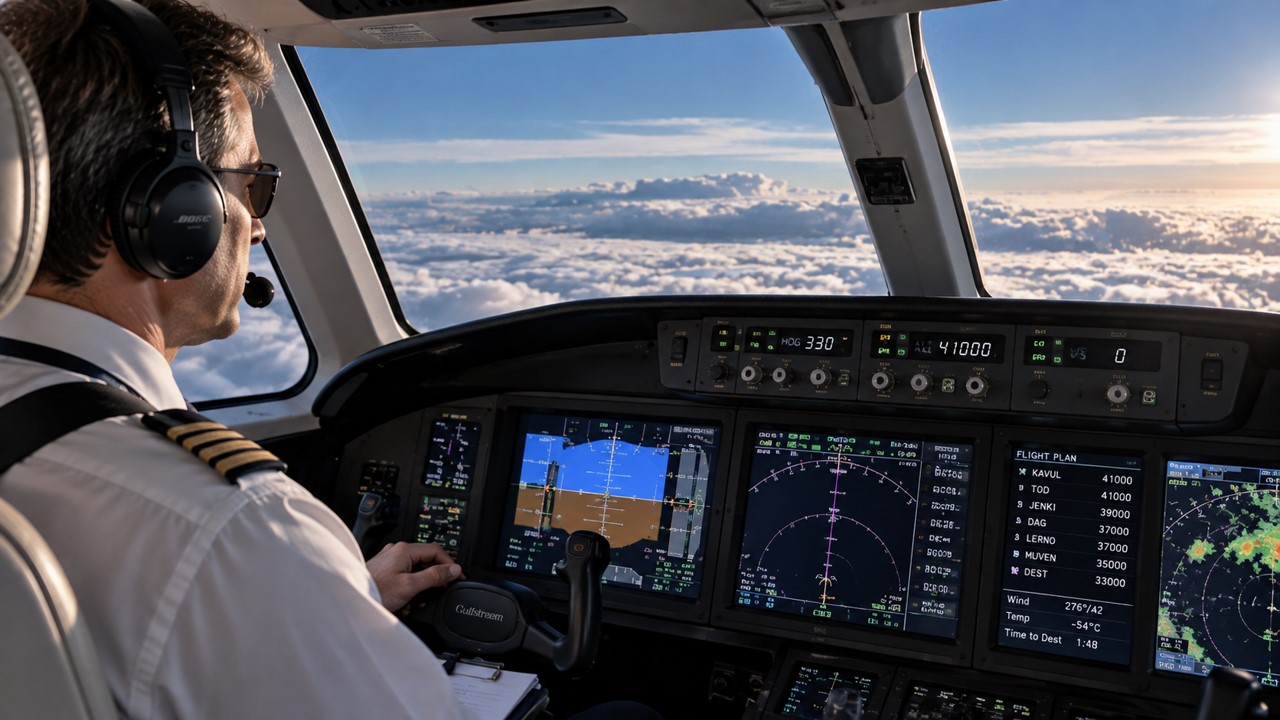
Modern aircraft can automate many control tasks.
Autopilot can maintain altitude, heading, speed, and flight path with extraordinary precision.
But automation does not eliminate the need to think ahead.
In some ways, it changes the cognitive task.
The pilot now has to understand:
This introduces another layer of prediction.
The pilot is not only forecasting the aircraft.
They are also forecasting the behavior of the automated system controlling it.
That becomes especially important when modes change, constraints interact, or automation behaves differently from what the pilot expected.
Air traffic control instructions often arrive while the crew is already managing other demands.
A new altitude.
A heading change.
A speed restriction.
A runway change.
A revised approach.
The instruction itself may be simple, but its cognitive impact depends on when it arrives.
An instruction received during a quiet phase may be easy to absorb. The same instruction during a high-workload phase can require rapid reprioritization.
Again, the issue is not merely information volume. It is whether new information arrives early enough to be integrated into the pilot’s existing plan without forcing rushed correction.
This is the deeper reason the phrase “ahead of the aircraft” is so useful. It captures something that is easy to miss if flying is viewed only as vehicle control.
Pilots are not just steering through the present. They are maintaining a moving model of the future.
That model includes:
The aircraft is always progressing toward the next constraint. The pilot’s job is to arrive there cognitively before the aircraft arrives physically.
Aviation makes this principle unusually visible, but it applies far beyond flying. In many complex environments, expert performance depends on preserving enough awareness of the future that decisions can be made before options narrow.
Pilots have to do this continuously because aircraft move fast, consequences compound, and later corrections can become increasingly expensive. The best pilots are not simply reacting well to what happens - they are constantly asking what the current situation is becoming.
Welcome to the Research and Strategy Services at in today's fast-paced.
Elite tennis returners do more than react quickly — they extract useful information before the ball is even struck. This article explores how anticipation, body cues, and rapid updating help players solve the return before the serve fully unfolds.
Elite athletes don’t need to look directly at everything to stay aware of a fast-changing play. This article explores how gaze and attention work together to monitor movement, spacing, and opportunity across the wider visual field.
Learn how modern sports medicine extends beyond treating isolated injuries with multidimensional rehabilitation approaches.
NeuroTracker is one of the most widely researched cognitive training systems, used in elite sports, military, and human performance settings worldwide. Built on 20 years of neuroscience research.